
Volunteer Corner: High School Environmental Science Career Program
Building tomorrow's future stewards of the earth promotes longevity of open spaces like The Nature Reserve. The High School Environmental Science Career Program began in 2020 and helps local high school juniors and seniors become more familiar with the careers in environmental science and land management.
Each meeting introduces a different professional in the field of environmental science and the role they play with The Nature Reserve and other projects in Orange County. These professionals have helped restore habitats, conducted research to ensure sensitive habitats were protected for the wildlife that relies on them, identified locations for the creation of underpasses on major roads for wildlife to travel more safely, and monitored for threats such as invasive species. They share tools and techniques they use in their jobs, how they became interested in environmental science and land management, and insights to guide the students in their educational paths.
David Smith, who specializes in environmental law and advises Rancho Mission Viejo and The Nature Reserve, introduced the students to what could be a very complicated issue. The students learned about the process Rancho Mission Viejo went through with various government agencies to mitigate environmental impacts and how they worked to integrate the preserved wild space with other reserves and park land to avoid a "postage stamp" effect in preserving the land.
Tom Millington, The Nature Reserve's Director of Environmental Compliance, talked about his role on the Nature Reserve and his background. Part of his job is monitoring habitats and breeding sites to ensure they are preserved. The students were given the task of locating bird nesting sites on the grounds of The Nature Reserve Headquarters to determine if they were active and which species they belong to. Students set up a wildlife camera near San Juan Creek where a number of different animal tracks had been seen. The camera captured animal movement around The Nature Reserve.
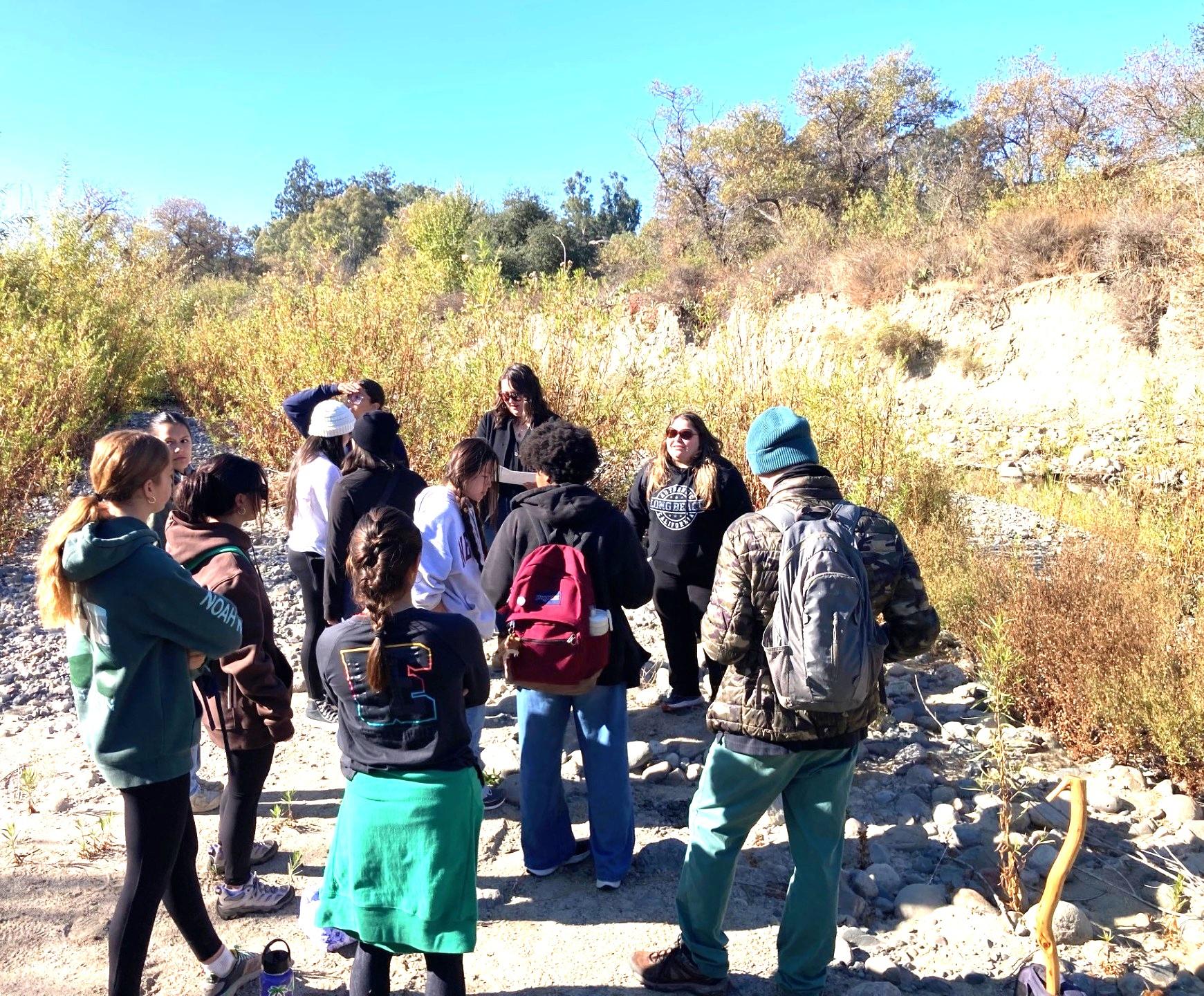
Hydrologists Jenny Robinet and Rianne Okamoto of PACE Advanced Water Engineering shared their work with the program participants. The students utilized GIS software to upload locations of potential waste and pollution runoff to San Juan Creek. They used a streamflow model to see how various surfaces and structures could be used to control water flow. They also conducted a streambank survey near Sendero Village in San Juan Creek to see how PACE helps with monitoring erosion and works to mitigate it before it damages homes and habitats.
Kristin Kartunen of GLA joined us to talk about her career working with Geographic Information Systems and the use of Unmanned Aircraft Systems (drones). The students had a hands-on activity with the ArcGIS Field Maps app used in collecting data on the ground that can be integrated into digital maps that are then used in land management, civil planning, and disaster management.
Charles Villafana from NOAA Fisheries Management shared his educational and career background and explained how NOAA helps preserve our fisheries and protect wildlife from getting caught up in that process. Methods varied to designing safer fishhooks, setting nets and traps at specific depths and mounting sonic warning devices to help keep whales from becoming entangled. The students estimated simulated fish populations with an array of fish-shaped crackers. The students had the opportunity to try on some of the immersion suits NOAA Fisheries researchers train with in the event their vessel is in danger of sinking. Each student had to put on their suit within one minute to pass. Fortunately, all were able to survive the tragic loss of their vessel.
Katie Farrington from GMU, a multidisciplined geotechnical, pavement, structural and civil engineering company, also presented. The students learned how geology plays a role in land management and development. Katie demonstrated how to read geologic maps representing the underlying rock and how it looks when we see them when we look at a hillside. The group hiked along Chiquita Ridge which overlooks much of Sendero, Esencia and Rienda communities. Katie discussed the various projects like Gobernadora bridge and how geology literally forms the foundation of developing and managing the landscape.
Because the program primarily draws from our local high schools, the students that participate in the program have a window not only into a growing professional environment, but make connections to the communities they live in. The time spent with a hydrologist will leave them noticing where runoff goes and what it carries eventually into the ocean. The wildlife they see and hear around their neighborhoods are viewed in a different light. They create a sense of stewardship that carries into the career they enter and on to their own family and communities, helping sustain the longevity of spaces like The Nature Reserve.
“I’m passionate about conservation and architecture and wanted to better understand how to create sustainable, efficient homes that respect and protect the beautiful environment.”
- Annabel Ayala
“I really enjoyed making new friends who were also excited to learn about the different jobs in environmental science. I also really enjoyed the interactive learning experience that helped me remember the content of the learning. Overall, it was an effective and fun educational experience.”
- Kyla Contreras
“The Environmental Science Career Program at The Nature Reserve taught many different career pathways that I could take in environmental science and conservation, and how they are all connected. It was a very hands-on experience, and I learned numerous field-work skills.”
- Isabella McCann