
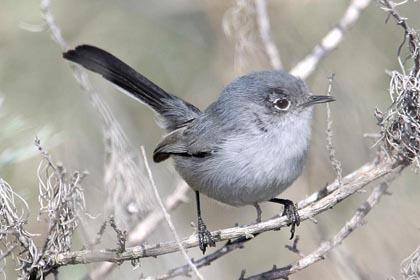
Species Spotlight: Coastal California Gnatcatcher
The coastal California gnatcatcher (Polioptila californica californica) is a small, non-migratory songbird and a year-round resident of coastal southern California and northern Baja California. Adults are dark blue-gray above and grayish white below, with a long, mostly black tail edged in white, a thin bill, and a narrow white eye ring. During the breeding season, adult males develop a distinctive black cap, while females retain a gray head. At only about 4.3 inches long and weighing roughly 0.2 ounces, the bird is often detected first by its soft, kitten-like mewing call.
Gnatcatchers are closely associated with coastal sage scrub, especially stands dominated by California sagebrush (Artemisia californica), California buckwheat (Eriogonum fasciculatum), sages (Salvia spp.), and other low-growing shrubs. They forage actively within and around shrub canopies, gleaning small insects and spiders from leaves and branches. Pairs maintain territories and may remain together throughout the year. Although strongly tied to sage scrub, gnatcatchers may also use adjacent chaparral, grassland, riparian vegetation, restored habitat, and habitat linkages for foraging and dispersal, particularly outside the breeding season.
Breeding generally extends from late February through early August, with most nesting attempts occurring from mid-March through mid-May. Both adults build a small, cup-shaped nest in a shrub or cactus, usually about 1 to 3 feet above the ground. A typical clutch contains three to five eggs, and both parents incubate the eggs and feed the young. Chicks leave the nest about two weeks after hatching but continue to associate with their parents while they learn to forage. Habitat loss and fragmentation, frequent wildfire, prolonged drought, invasive plants, urban-related predators, and brood parasitism by brown-headed cowbirds can reduce habitat quality or reproductive success.
As part of the HCP monitoring and adaptive management program, the Rancho Mission Viejo Land Trust monitors coastal sage scrub vegetation and gnatcatcher occupancy, evaluates potential stressors, and implements management actions to maintain habitat quality and connectivity. The conservation strategy protects and manages approximately 12,191 acres of coastal sage scrub in the Habitat Reserve and includes restoration, invasive-species control, fire management, and protection of key habitat linkages. These coordinated actions are intended to sustain major and important gnatcatcher populations, support dispersal, and maintain the long-term ecological function of coastal sage scrub within the Planning Area.